September 25, 2026
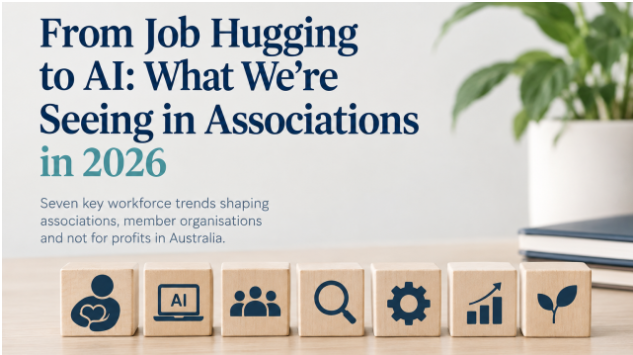
By Jo Brown I recently presented on emerging workforce trends affecting associations, member organisations and not for profits across Australia. The headlines tend to focus on skills shortages, AI and economic uncertainty, but the deeper story is about changing expectations, from employees, candidates, boards and CEOs, often all shifting at once. Based on what we're seeing across executive search, recruitment and workforce planning projects, here are seven trends worth paying attention to. 1. People are moving less, but that doesn't mean they're happier Australian workers are changing jobs less frequently than they were a few years ago. After the post pandemic mobility spike, many employees are staying put, with national job mobility falling to 7.2% last month. Don't be too quick to read your lack of leavers as loyalty. In many cases, people are exercising caution. Cost of living pressures, economic uncertainty and a thinner pool of attractive opportunities have led to a kind of "job hugging", where security wins out over change. At CEO level, tenure is increasingly shaped by board alignment, financial pressures, governance complexity and the pace of organisational change. A long serving CEO can offer real continuity, but boards should still ask the harder questions about succession, leadership depth, and whether organisational capability is keeping pace with member expectations. For candidates, the narrative around tenure matters more than ever. Frequent movement needs a clear explanation of outcomes and context. Long tenure needs to be backed by evidence of growth, renewal and increasing responsibility, and candidates need to articulate that clearly at interview. 2. More candidates doesn't always equal better candidates Candidate quality remains the defining challenge for association leaders. Application volumes have recovered across many operational and mid level roles, yet the pool of candidates who genuinely understand member organisations, governance environments and complex stakeholder ecosystems has not grown at the same pace. Identifying this level of talent still depends on human judgement, not solely on the volume of applicants. Specialist capability is particularly scarce across policy and advocacy, workplace relations, governance, digital engagement and senior communications. Organisations may need to rethink remuneration if they want to attract and retain talent in these critical roles. At executive level, the strongest candidates are usually not actively looking. They're employed, performing well, and highly selective. What attracts them isn't simply salary or title, but board quality, clarity of mandate, financial sustainability, reputation and strategic direction. The best of them can also explain clearly how they build influence and drive outcomes through relationships, credibility and stakeholder engagement, understanding that advocacy is often a long game where success isn't always measured in immediate wins. 3. Application volume is creating more noise Candidate shortages remain in some areas, but application volume has increased significantly, and more applications don't necessarily create better outcomes. Many hiring managers are spending longer identifying genuinely relevant candidates, particularly as AI assisted applications become more common and jobseekers apply across multiple opportunities at once. In our own recruitment processes, a significant proportion of applications simply aren't aligned with the role requirements, even as jobseekers face fewer vacancies and stronger competition. This environment rewards quality over quantity. For associations, it underscores the value of preparation before going to market: a clear job scope, appropriate salary positioning, agreed interview processes and current, ready to go employment contracts all make for a smoother search. At executive level, boards should pay particular attention to alignment. Experienced candidates quickly pick up on disagreement around organisational priorities, the CEO mandate or the type of leader required, and if those questions remain unresolved, the market will notice. A strong brand helps attract interest, but it cannot compensate for an unclear brief or below market conditions. 4. Job creep is real This is one of the biggest themes coming through candidate conversations: across many associations, fewer people are being asked to do more. Membership, communications, events, partnerships, digital engagement and commercial responsibilities are increasingly folded into broader roles. Sometimes this works well. Leadership positions can successfully span multiple functions when authority, resources and priorities are clear. The trouble starts when organisations combine several previously separate jobs without adjusting expectations, support or pay. Don't assume your people are content simply because they're staying. Many employees are choosing stability while privately feeling stretched, frustrated or uncertain about where their progression goes from here. For boards undertaking a CEO succession process, this adds another layer worth considering. Succession shouldn't be about replicating the departing executive. It is an opportunity to reassess the leadership mandate and define what the organisation actually needs next. At every level, clear career pathways and meaningful progression are becoming essential retention tools, especially for organisations that cannot compete on remuneration alone. 5. The capability mix is changing Association leaders are being asked to operate across an increasingly complex environment, where member value, advocacy, governance, commercial sustainability and stakeholder influence can no longer sit in separate conversations. At the same time, digital literacy and confidence with data are becoming baseline expectations rather than specialist skills. At executive level, sector experience remains highly valuable, but boards are increasingly looking beyond traditional career pathways. The real differentiators are often enterprise leadership, political judgement, change capability, strategic influence, and the ability to balance member expectations against organisational sustainability. Candidates from other sectors can bring a genuinely fresh perspective. The key is being clear about which capabilities are essential and which can be learned on the job. 6. AI will change work more than it eliminates work The AI conversation keeps evolving, but despite some of the more dramatic headlines, what we're seeing in practice is that AI is changing tasks rather than removing entire roles. Recent sector research bears this out: around 67% of Australian not for profits are already using generative AI, yet only about 14% have a policy or governance framework in place. For associations, the immediate opportunity lies in improving productivity across administration, communications, reporting, research and member services, provided technology adoption is balanced with human judgement and proper governance. For candidates, simply listing AI as a skill is unlikely to impress. What employers actually want to understand is how technology has improved decision making, service delivery, productivity or outcomes. A recent topic of conversation was the realisation from a CEO that simply giving someone an AI licence is not the same as teaching them how to use it! Training, governance and capability development around AI will be critical part of employee ongoing professional development. For CEOs, the expectation is rarely technical expertise itself. Boards are looking for leaders who can guide adoption, manage risk, protect data and navigate their workforce through change with confidence. 7. Workforce agility needs structure Many associations are increasingly turning to interim, temporary and contract appointments to manage transformation, parental leave, funding uncertainty and leadership transitions, and this flexibility can be highly effective. But agility should not tip into ambiguity. People still need clarity about accountability, decision making authority and expected outcomes. Whether a role exists to maintain operations or deliver change should be obvious to everyone involved. The strongest workforce planning approaches identify capability gaps and succession risks before vacancies actually occur. Too often, recruitment is still treated as a reaction to resignation rather than part of a broader talent strategy. Finally... It is no secret that I love the sector I support. The associations sector remains one of the most purpose driven and rewarding sectors to work in, but expectations are rising at every level of the workforce. Boards need greater clarity around leadership mandates. CEOs need broader capability. Managers need to balance increasingly complex remits. Candidates need stronger evidence of impact, adaptability and growth. The organisations that navigate this best will be the ones that treat people as a strategic capability rather than a transactional recruitment exercise. The market may be changing, but good leadership, clear thinking and strong organisational alignment remain as important as ever. Beaumont People's associations team specialises in supporting for-purpose member organisations. If you require executive search services, recruitment support or market guidance, please do not hesitate to reach out. jo@beaumontpeople.com.au